The Seismic Shift in Caracas: US Intervention and the Arrest of Nicolás Maduro
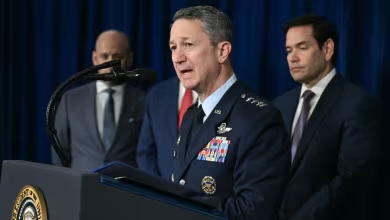
In a weekend operation that has fundamentally altered the political landscape of the Western Hemisphere, United States special forces apprehended Venezuelan President Nicolás Maduro and his wife, Cilia Flores, on January 3, 2026. The high-stakes mission followed a series of precision airstrikes targeting strategic military installations across northern Venezuela, effectively neutralizing the regime's command and control infrastructure. The capture, confirmed by the Trump administration, marks the most significant direct military intervention by the United States in Latin America in decades, signaling a radical shift in Washington’s approach to regional security and the influence of extra-regional powers like China and Russia.
The operation was justified by U.S. officials as a necessary action to dismantle what they characterized as a "narco-state" and to address long-standing allegations of Maduro’s involvement with international drug cartels. Analysts suggest the timing of the intervention reflects a broader strategic pivot by the current U.S. administration to reassert dominance in its "near abroad" while simultaneously countering the economic and military footprints of Beijing and Moscow in the region. As of January 5, Venezuela remains in a state of high tension, with a burgeoning political vacuum prompting both domestic opposition leaders to scramble for power and international observers to warn of a potential humanitarian and security crisis if a stable transition is not immediately brokered.
Global Markets React: A Tale of Two Realities
The financial world has responded to the Venezuelan upheaval with a mixture of shock and opportunistic repositioning. By the opening of trade on Monday, January 5, 2026, global markets exhibited sharp volatility. In a move that surprised some energy analysts, crude oil prices slipped during early trading. While geopolitical instability in an oil-producing giant typically drives prices upward, investors appear to be pricing in the possibility of a swift removal of U.S. sanctions and a long-term return of Venezuelan supply to the global market under a more Western-friendly administration. However, this downward pressure is tempered by the immediate uncertainty regarding the integrity of Venezuela’s state-owned energy infrastructure following the January 3 airstrikes.
Conversely, the demand for safe-haven assets has skyrocketed. Precious metals, including gold and silver, saw a significant surge as investors fled to hard assets to hedge against the "geopolitical whiplash" of the Maduro arrest. Market watchers describe the current sentiment as "tense and opportunistic," with many institutional investors bracing for a broader "repricing" of risk across emerging markets. The suddenness of the U.S. action has reinforced the narrative that 2026 will be a year where geopolitics, rather than macroeconomic indicators alone, dictate market direction.
Asian Markets Defy Gravity: The Nikkei 225 Hits Record Highs
Despite the chaos in the Caribbean, Asian markets opened the first full week of 2026 on a remarkably bullish note. Japan’s Nikkei 225 index jumped 3% to close at 51,853.53, a historic high that resumes the momentum seen at the end of 2025. This rally was mirrored in South Korea and other regional benchmarks, which also set new records. Analysts attribute this divergence from the West to a "relief rally" regarding regional stability and strong performance in the technology and semiconductor sectors.
The surge in Asian equities suggests that investors in the East are currently prioritizing local growth trajectories and the potential for de-escalation in other global hotspots over the immediate fallout in Latin America. However, the shadow of US-China trade tensions remains a persistent concern. While the Nikkei celebrates record highs, the underlying anxiety regarding supply chain fragmentation and the ongoing "critical minerals race" continues to inform the long-term strategies of major Asian conglomerates.
European Integration: Bulgaria Adopts the Euro
While the Americas deal with regime change, Europe marked a milestone of integration. On January 1, 2026, Bulgaria officially joined the Eurozone, becoming the 21st nation to adopt the single currency. The transition from the Bulgarian lev to the euro was reported as smooth, signaling a significant victory for the European Central Bank and the European Union’s efforts to expand the currency union despite the prevailing global trend toward deglobalization. For Bulgaria, the move is seen as a strategic anchor to the West, providing both economic stability and a heightened level of security within the European framework at a time of heightened continental tension.
Domestic Milestones: A Historic Inauguration in New York City
In the United States, the start of the year was also marked by a historic shift in local governance. On January 1, 2026, Zohran Mamdani was sworn in as the Mayor of New York City. Mamdani’s inauguration is a landmark event in American politics, as he becomes the first Muslim and the first Asian American to lead the nation’s largest city. His administration takes office at a time when urban centers are grappling with the local impacts of global economic shifts, and his platform—focused on housing and social equity—will be closely watched as a potential model for progressive governance in a polarized national environment.
The Strategic Pivot: US-China Relations and the April Summit
Looking ahead, the geopolitical calendar is dominated by the anticipated April summit between President Trump and Chinese President Xi Jinping. This meeting is expected to be a critical juncture for global trade, with both nations seeking tentative deals on sensitive issues. High on the agenda is the trade of U.S. semiconductors in exchange for guaranteed access to Chinese critical minerals and rare earths. China’s dominance in this sector, reinforced by expanded export controls in October 2025, has made the "critical minerals race" a primary driver of national security policy in Washington. The summit will determine whether the world’s two largest economies can find a "geoeconomic" middle ground or if the trend toward bifurcated supply chains will accelerate.
The Nuclear Precipice: The Impending Expiry of New START
A looming deadline of even greater consequence is February 5, 2026, the date the New Strategic Arms Reduction Treaty (New START) is set to expire. Without a successor agreement, the United States and Russia—who together control 87% of the world’s nuclear warheads—will be left without binding limits on their deployed strategic arsenals for the first time in decades. Experts warn that the lapse of the treaty could lead to a rapid expansion of nuclear forces, with projections suggesting a potential increase to over 6,000 deployed warheads within the next ten years. The loss of transparency and the verification mechanisms provided by New START adds a layer of extreme risk to an already volatile international security environment.
Ongoing Conflicts and Fragile Peaces
The global security landscape remains marred by unresolved conflicts. In Ukraine, there is a persistent, albeit fragile, expectation of movement toward a negotiated settlement. Analysts suggest that the exhaustion of resources and the shifting priorities of Western backers may lead to a deal involving territorial concessions in exchange for sovereign security guarantees. Meanwhile, in the Middle East and parts of Africa, ceasefires remain tenuous. The "perfect storm" of weak global governance and regional instability has led to a fragmented order where localized conflicts, such as those in Sudan and Yemen, continue to simmer with little prospect of immediate resolution. The international community’s bandwidth is currently stretched thin, with the focus sharply divided between the new crisis in Venezuela and the systemic rivalry in the Indo-Pacific.
Conclusion: A World of "Geopolitical Whiplash"
As of January 5, 2026, the global community finds itself in a state of profound transition. The arrest of Nicolás Maduro has demonstrated a renewed American willingness to use direct force to achieve political objectives, a move that has sent ripples through both commodity markets and diplomatic circles. While some regions, like the Eurozone and parts of Asia, show signs of resilience and growth, the overarching theme of the new year is one of uncertainty. Between the risk of a new nuclear arms race and the high-stakes negotiations between the U.S. and China, the "repricing" of global risk is only just beginning. For investors and policymakers alike, the events of the first five days of 2026 serve as a stark reminder that the post-Cold War order has been replaced by a multipolar environment where volatility is the only constant.
Comments (0)
No comments yet. Be the first to share your thoughts!