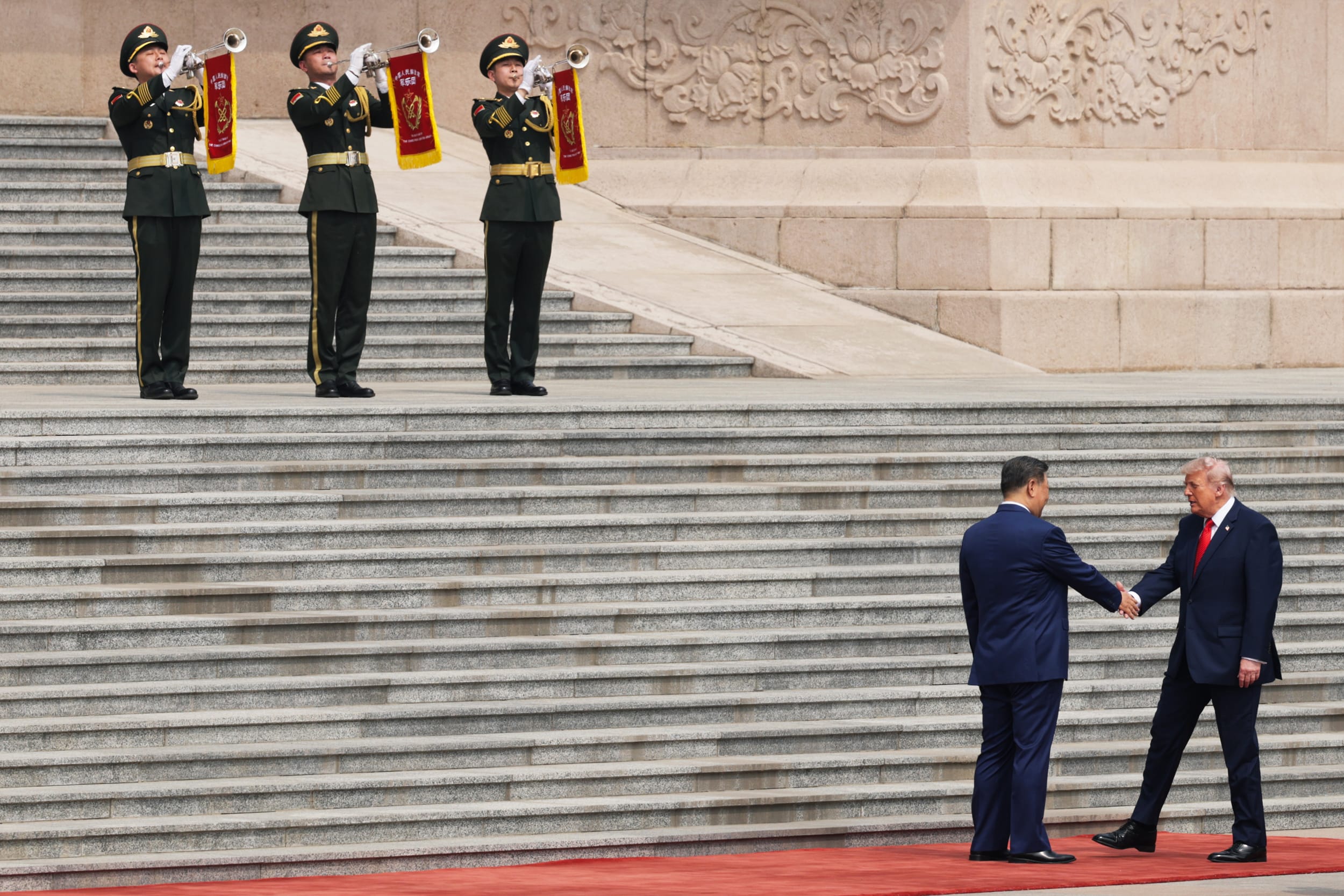
Beijing, China — In a high-stakes diplomatic encounter, U.S. President Donald Trump and Chinese President Xi Jinping have engaged in discussions aimed at stabilizing international security and addressing the ongoing war in the Middle East.
The meeting, held in Beijing, comes at a critical juncture for global geopolitics. While President Trump described the talks as producing "fantastic trade deals" and suggested the two sides were in close agreement, official Chinese Foreign Ministry statements as of May 15, 2026, have yet to confirm a finalized "series of new consensuses." Despite the lack of a formal pact, global markets have trended higher on optimism that the world’s two largest economies are moving toward a recalibration of trade relations and a shared interest in resolving the Iran conflict.
The summit occurs against the backdrop of a regional war that began on February 28, 2026, following coordinated airstrikes by U.S. and Israeli forces on Iranian leadership and nuclear infrastructure. The death of Supreme Leader Ali Khamenei, reported by U.S. and Israeli intelligence to have occurred during the strike on his Tehran compound, and the subsequent retaliatory blockade of the Strait of Hormuz by Iranian forces have created the most significant global energy disruption in decades. The Beijing talks signal a potential shift in China’s role, as the disruption of oil flows appears to be pushing Beijing toward a more active dialogue with Washington to secure maritime routes.
Discussions on the Iran Conflict
Central to the Beijing summit was the deteriorating security situation in the Persian Gulf. President Trump maintained a dual-track approach during the talks, combining aggressive rhetoric toward Tehran with an openness to a "fantastic deal." While reports indicate that Trump communicated the necessity of a comprehensive diplomatic resolution, the specific terms of any ultimatum delivered through Chinese officials remain unverified.
China, which has historically maintained close economic ties with Iran, appears to be weighing its posture. Analysts suggest that the reduction of oil throughput in the Strait of Hormuz—which fell from its normal range of 20–22 million barrels per day to 14.6 million in the first quarter of 2026—has forced Beijing to prioritize maritime stability. While a formal agreement on crisis management has not been signed, the talks focused on several key areas of concern:
- A shared interest in ensuring the Strait of Hormuz eventually returns to international shipping.
- The consensus that Iranian nuclear weapons capability remains a red line for global security.
- Potential coordination regarding the safety of strategic waterways, such as the Bab al-Mandab Strait, should hostilities continue to escalate.
Trade Stabilization and Economic Agreements
Parallel to the security discussions, the Beijing summit produced tangible progress in the U.S.-China trade relationship. In an effort to stabilize markets, President Trump announced on May 15, 2026, that China has agreed to a major purchase of American goods. Most notably, reports from the summit indicate that China has placed an order for 200 Boeing aircraft, a move seen as a major step toward narrowing the trade deficit.
The following table outlines the key components of the trade stabilization efforts discussed in Beijing:
| Sector | Agreement Details | Strategic Objective |
|---|---|---|
| Aerospace | China to purchase 200 Boeing aircraft. | Support for U.S. manufacturing and narrowing the trade deficit. |
| Agriculture & Energy | Discussions regarding increased purchases of U.S. commodities. | Stabilizing the U.S. export economy and diversifying China's energy sources. |
While the immediate reaction from global markets has been cautiously optimistic, skeptics point to long-standing grievances regarding intellectual property and technology transfers. Furthermore, while the U.S. administration has characterized the talks as a breakthrough, the Chinese side continues to emphasize that Taiwan remains a "red line" and a matter of national sovereignty that must be respected.
Strategic Shifts: China’s Long-Term Resilience Planning
Despite the apparent cooperation in Beijing, geo-monitoring outlets suggest that China is simultaneously preparing for a more confrontational long-term environment. Analysis from Geopolitical Monitor highlights that Beijing is aggressively strengthening its domestic sanction-busting capacity. This planning is viewed not only as a response to the current Iran-related sanctions but as a preparation for a potential future contingency regarding Taiwan.
Xi Jinping reportedly reiterated that Taiwan remains a "red line" during the summit. While the rapport between the two leaders appears improved, Chinese state media continues to emphasize the importance of "national sovereignty" and "sanctions resilience." This suggests that while Beijing is willing to cooperate on the Middle East to protect its immediate economic interests, it remains committed to building a financial and industrial infrastructure capable of withstanding a potential decoupling from the Western financial system.
The Humanitarian Front: Russia-Ukraine Prisoner Exchange
In a separate development, a major humanitarian milestone was reached in the Russia-Ukraine conflict. Mediated by the United Arab Emirates (UAE), the two warring nations conducted a "205-for-205" prisoner exchange on May 15, 2026. The Russian Ministry of Defense confirmed the swap, stating that the 205 Russian personnel were transported to Belarus for medical and psychological evaluation.
Ukrainian President Volodymyr Zelenskyy confirmed the exchange on May 15, identifying it as the first stage of a larger 1,000-for-1,000 swap. The involvement of the UAE in this mediation underscores a broader trend of regional powers leveraging diplomatic relationships to achieve localized de-escalation, even as the underlying territorial disputes between Kyiv and Moscow remain unresolved.
Military Stance and Regional Retaliation
The war in the Middle East remains the most volatile element of the current global news cycle. Since the initial strikes on February 28, the conflict has evolved into a campaign of high-tech strikes and maritime blockades. Following the reported death of Supreme Leader Ali Khamenei, Iranian retaliatory strikes have targeted U.S. assets in the region and Israeli population centers.
The closure of the Strait of Hormuz remains the primary "choke point" for the global economy. By mining the strait and deploying missile batteries, Iran has significantly disrupted the flow of oil through a passage that normally carries roughly 20% of global petroleum liquids consumption. This move has led to a dramatic spike in insurance premiums and has forced tankers to take the long route around the Cape of Good Hope, significantly increasing costs for European and Asian consumers.
The discussions in Beijing suggest that Iran may face increasing isolation. If China continues to pivot toward a maritime security partnership with the U.S. to protect its own energy interests, the Islamic Republic’s primary economic lifeline—oil exports to China—could be permanently severed. This potential shift represents a fundamental change in the 21st-century security architecture.
Global Reactions and the Path Forward
The reaction to the Trump-Xi summit has been polarized. In Washington, supporters of the administration have hailed the discussions as evidence of a successful "America First" strategy. Conversely, critics argue that a formal agreement is still lacking and that the trade concessions may be temporary. In Europe, NATO and EU leaders are closely monitoring the situation, concerned that a "G2" management of global affairs by the U.S. and China could marginalize European interests.
Summary of Current Geopolitical Status
As of May 15, 2026, the global landscape is defined by three intersecting trends: the active war in Iran, the tactical realignment of U.S.-China relations, and the fragile humanitarian progress in Eastern Europe. The following list summarizes the current state of play:
- U.S.-China Relations: Moving toward a framework of "managed coexistence" marked by a major Boeing order, though a formal security pact remains unconfirmed.
- The Iran Conflict: High-intensity hostilities continue; the reported death of Ali Khamenei and the Hormuz blockade have caused unprecedented energy market volatility.
- Energy Markets: Severe disruption persists as the Strait of Hormuz remains contested, impacting a route that handles 20% of global oil flows.
- Eastern Europe: A 205-for-205 prisoner exchange mediated by the UAE has been confirmed by both Russia and Ukraine, signaling a moment of humanitarian relief.
The coming weeks will be decisive. The world waits to see if the combination of U.S. military pressure and China's shifting economic priorities will bring Tehran to the negotiating table. For now, the "Beijing talks" stand as a significant, if unfinalized, attempt to prevent a regional conflict from spiraling into a broader global crisis.
Reporting from the international desk, this remains a developing story. Further details on the U.S.-China trade implementation and the subsequent stages of the Russia-Ukraine prisoner swap are expected later this week.
Comments (0)
No comments yet. Be the first to share your thoughts!